Which Is the Better Choice for Overseas Projects: Prefabricated Housing or Traditional Construction?
Jan 31,2026
Which Is the Better Choice for Overseas Projects: Prefabricated Housing or Traditional Construction?
In overseas projects, the construction decisions regarding accommodation camps, temporary office areas, and on-site supporting facilities directly impact project budget control and overall profitability. Many overseas projects hesitate between prefabricated housing and traditional buildings: traditional buildings seem "robust and durable," while prefabricated housing offers attractive initial cost-effectiveness. But in the long run, which option is more cost-effective?
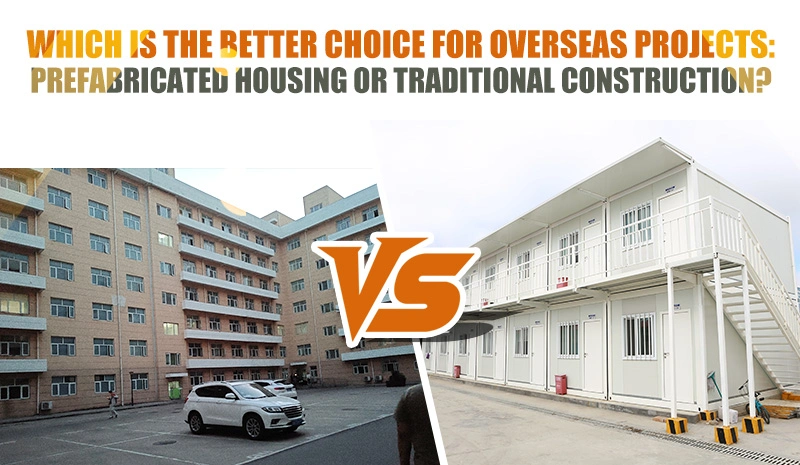
I. Initial Investment: How Does the "Quick and Convenient" Advantage of Prefabricated Housing Outweigh Traditional Buildings?
1. Direct Costs: Initial investment differences can reach 50%, with material and labor costs dominating.
The initial costs of traditional buildings are characterized by "multiple points of dispersion and continuous growth." For traditional brick-and-mortar structures, the procurement of building materials alone, such as cement, bricks, and steel, can account for up to 45% of the total investment. Local labor costs further increase due to long construction periods, easily leading to cost overruns per square meter. Furthermore, overseas building material prices frequently fluctuate.
On the other hand, prefabricated housing achieves cost optimization through "factory prefabrication and bulk purchasing." The product itself is priced using either "FOB" (Free On Board) or "CIF" (Cost, Insurance and Freight), with a clear package price including the main structure, insulation materials, wiring, doors and windows, and all other components. The transportation method utilizes a nested, folding design to maximize container space and effectively reduce unit costs.
Prefabricated houses have extremely low foundation requirements, requiring only simple concrete piers or strip foundations. Compared to traditional buildings using deep foundations, this saves 50%-70% on foundation costs. The modular design allows for rapid hoisting and assembly, significantly saving labor and machinery usage time.
2. Time Costs: 60% Shorter Construction Period, Early Production Brings Hidden Benefits
The principle of "time is money" is particularly evident in overseas projects. Every month of delay increases the chain of costs associated with equipment downtime and personnel downtime. Traditional buildings, affected by weather and construction sequence, typically require 6-8 months or even a year to be operational. During rainy seasons or when building materials are scarce, the delay rate can exceed 30%.
Modular prefabricated housing production has revolutionized this landscape. Factory prefabrication and on-site foundation construction can proceed simultaneously, with assembly completed within 12 hours. Even including international shipping time, completion can be achieved within 2-3 months. This speed advantage translates directly into benefits for emergency rescue projects, and in commercial projects, it allows for the early activation and use of campsites, indirectly reducing project waiting costs.
3. Hidden Costs: The "Underestimated" Compliance and Risk Costs of Traditional Construction
Hidden costs for overseas projects are often high, putting traditional construction at a significant disadvantage. Firstly, there are compliance costs. Different countries have varying certification requirements for building materials. Traditional building materials must undergo local testing individually, a cumbersome and expensive process. Prefabricated houses, on the other hand, can obtain international certifications such as CE and ISO in advance, directly meeting target market standards upon export.
Secondly, there are risk costs. Traditional construction is highly susceptible to the effects of the natural environment. High temperatures in the Middle Eastern deserts and typhoons in Southeast Asia can cause work stoppages. Daily downtime can result in losses of tens of thousands of dollars just for equipment rental costs. Prefabricated houses require only 10% of the on-site construction work of traditional buildings, and modular construction can be completed in about a week, minimizing the risk of weather disruptions.
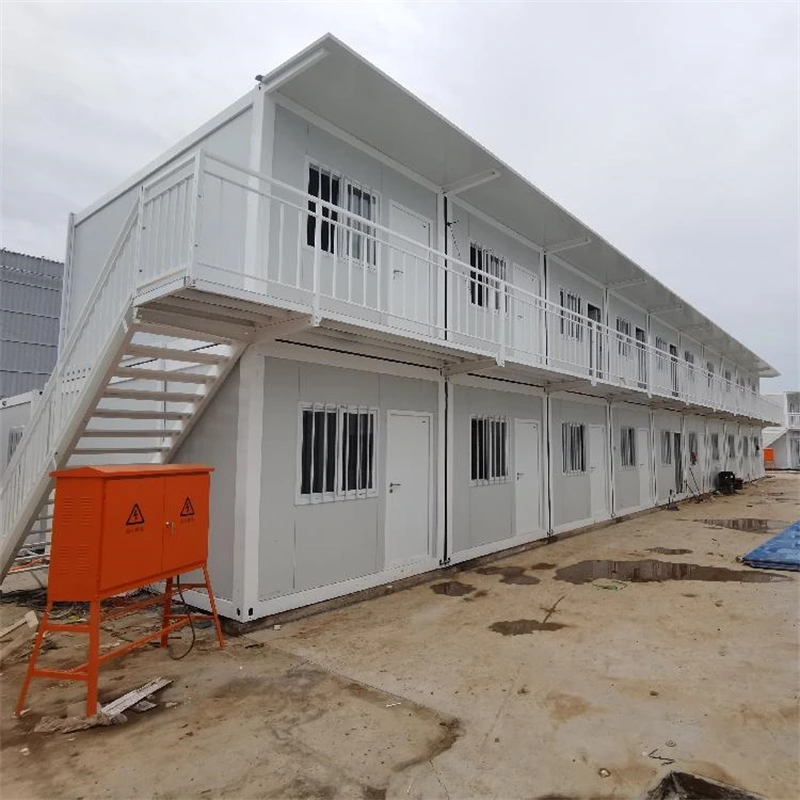
II. Long-Term Returns: Are the "Life Cycle Benefits" of Prefabricated Houses Truly Sustainable?
Many people worry that prefabricated houses are "not durable," but actual data shows that in overseas projects, the maintenance costs, reuse value, and energy efficiency of prefabricated houses actually provide long-term return advantages throughout their entire life cycle.
1. Maintenance Costs: Annual expenditures differ by a factor of two, with even more significant advantages in extreme environments
The maintenance costs of traditional buildings increase with age. Brick and tile structures require regular maintenance to address issues such as wall cracks and aging waterproofing. In the high-humidity environment of Southeast Asia, the average annual maintenance cost can reach 2%-3.5% of the total house price. Traditional buildings in the Middle Eastern desert also require frequent exterior wall insulation repairs, meaning a major renovation is needed every 5 years.
Maintenance of prefabricated houses is much more "worry-free and effortless." The annual maintenance cost of corrosion-resistant container houses accounts for only 1%-2% of the total price, mainly focusing on the inspection of connectors and the replacement of insulation layers. Prefabricated integrated houses use galvanized steel frames and sandwich insulation panels, maintaining structural stability even in extreme environments such as magnitude 8 earthquakes and force 12 winds, requiring no frequent major repairs. Even in high-salinity areas, the maintenance cycle of corrosion-resistant integrated houses is 50% longer than that of traditional steel structure houses.
2. Reuse Value: 98% utilization rate creates secondary income, while traditional buildings can only be demolished and abandoned.
Overseas projects often face the challenge of disposing of temporary facilities. Traditional building demolition costs are high, and material recycling rates are low, essentially making it a "one-time investment." Modular houses, however, have extremely high reusability; professionally disassembled and reassembled container houses can achieve a reuse rate of over 98%.
High-quality container houses are designed for a lifespan of 10-15 years or even longer and can be repeatedly disassembled and reassembled 5-8 times. After the first project is completed, they can be relocated to the next project or sold locally at a discounted price. Even after prefabricated houses reach their designed lifespan, their steel recycling rate remains above 90%, whereas traditional brick and tile structures can only recover a small amount of steel after demolition, with the remainder becoming construction waste requiring additional disposal costs.
Construction choices for overseas projects are never black and white, but rather a balance between short-term costs and long-term benefits. The "initial stability" of traditional construction often hides ongoing hidden costs, while the "upfront cost savings" of prefabricated houses can be translated into long-term benefits through their reusability and low maintenance costs.
For most overseas engineering projects, the industrialized characteristics of prefabricated houses perfectly address the pain points of overseas markets, such as cost fluctuations, tight schedules, and complex environments. Modular housing from China is not only "pre-made food" for the construction industry but also a "golden key" to solving overseas construction cost issues. After all, in the profit model of overseas projects, seizing opportunities with the lowest initial investment and ensuring long-term cost control and stable operation is the truly optimal solution.





 شبكة ipv6 المدعومة
 CALL US : +86 13631414627
 EMAIL : sales906@cbox.ltd


